

A very topical question as Glasgow is now engrossed in COP26 and the Climate Emergency dominates our media both social and mainstream. The old adage think Global act local seems extremely relevant and undoubtedly the impact of our environmental actions locally will affect the planet wholesale, but equally worrying is how that initial local impact then bounces back to bite us all in the bahookie a second time. The mess in our streets can make our daily lives miserable and hazardous but the bigger story is how that detritus then ends up in our waterways and the oceans and then ultimately in our food chain and then it comes back to our community to poison ourselves and our families through our diets, other consumptions and the quality of the air and environment around us.
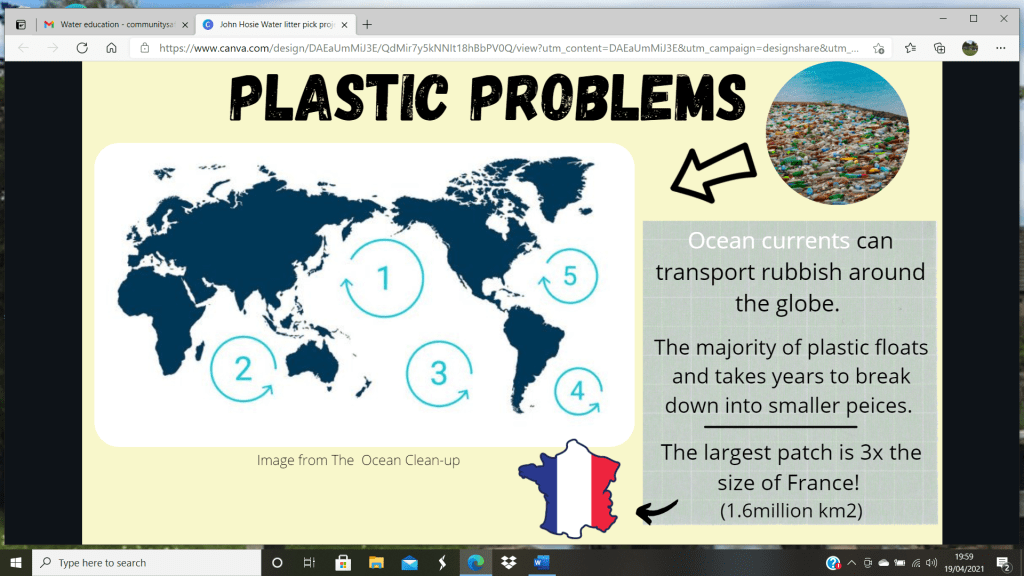
Back in April of this year I supported a groups of young people from Camelon and Tamfourhill to take part in canal clear up day which also involved an environmental learning workshop , let’s look back to an earlier blog when I noted the following: A recurring theme throughout the Canal clear ups was how our littering actions locally actually impact upon the world globally and then come back to affect the quality of our lives locally. A big circle of environmental damage and pollution that will affect every one of us in our daily lives. The young people who took part in the workshop sessions held at Tamfourhill Community Hub came up with highly creative ideas about how we can start to reduce the damage that we are causing by our constant use and dependency upon plastics. Their ideas are detailed in this blog of 20th April 2021 https://opcamelontamfourhill.co.uk/2021/04/20/

It is rather disturbing when you take a moment to reflect upon how climate change will affect the communities of Camelon and Tamfourhill; Climate Change will significantly impact upon our :safety in the outdoors, our safety in the home and upon our personal health and wellbeing, I attended a recent community safety webinar and here is a concerning list drawn up by the participants of how climate change will affect us locally:
- Regular flooding of our homes and streets and communal spaces like parks.
- Increased spread of disease through broken sanitation and sewage systems.
- Accidents and drownings through flooding.
- A significant increase to the cost of our home insurance.
- Erosion of the land and fertility of the soil.
- Disruption to our transport networks and infrastructures greatly reducing our mobility and connectedness.
- Wildfires and the destruction of forests.
- Unsafe and polluted beaches.
- Civil unrest, increase in criminality and anti-social behaviour.
- Isolation, mental health issues and a higher incidence of drug and alcohol dependency.
- Harder to access health and social care services.
- Economic disruption leading to unemployment and increased levels of poverty.
I think I will stop there as this list is extensive and to be honest never ending , these circumstances get worse as these affects will not be experienced universally as those already disadvantaged by inequalities: in health, poor housing and poverty will be much worse affected by the climate emergency than those geographic areas and communities that are socially and economically better off. In other words, If you live in an already socially and economically disadvantaged community then to use a rather unfortunate and overused cliché: this is the perfect storm.
Cop 26 in Glasgow offers some hope of dialogue with resultant action on a global macro level, but in terms of community safety we also need to be taking local actions immediately and with absolute urgency. I would want to positively emphasise that as individuals, families, and communities that we can be a part of the solution and that we can play a critical role in bringing about the changes that our planet requires through our immediate local actions. The current crises impacts on us locally, but the solutions involve actions at distinct levels , the solutions to this Climate Crises are therefore dynamic and interdependent:
- Macro, Global & Structural : This is where the onus is on national governments ,however we must ensure they act and listen to our concerns and demands. Multinational companies and governments (local & national ) must be held to account , it’s the current economic system versus the planet, as individuals and communities we must keep pressure on the decision makers and our elected representatives from Community Councils, the Local Authorities and through to our governments in Edinburgh and London. We need greater fairness, and we need to combat poverty and inequality , we need economic and climate justice for our most vulnerable local communities.
- Local: & Community: The actions we take locally are critically important and we can look no further than to some of the ideas and strategies identified by the young people who took part in our canal clear up workshops for a source of direct action and activity. The establishment of our #tidycleangreen group (https://opcamelontamfourhill.co.uk/tidycleangreen/ ) is an excellent example of the types of activity that we need in order to look after our communal green spaces and parks, to tidy them up and keep them greener and cleaner thus facilitating sustainability and greater biodiversity. Community growing projects and establishing local food production and distribution networks can contribute to combating poverty especially through aligning these initiatives with the local food pantry’s. As a community we can encourage positive behaviour change through promoting positive nudge activities, and this particular approach will be addressed locally in the near future through the #tidycleangreen groups creative messaging project which has been made possible through the funds the Group secured from the Councils Environmental Improvement Fund. Local youth workers and community activists can take part in carbon literacy training, and we can then start to run our Community Hubs and buildings on a net zero basis, reducing our carbon footprints and delivering services locally that are sustainable and have no negative environmental impacts. An opportunity currently exists through the Community Climate Action Plan (CCAP) The application process is now open and Keep Scotland Beautiful will be supporting several communities to develop their own unique plan to address the climate emergency. Full details can be found here: https://www.keepscotlandbeautiful.org/news/oct-2021/applications-for-community-climate-action-plan-programme-now-open/ The programme will involve a set of workshops with community members, empowering them to find opportunities for climate action in all areas of community life.
- Individual & personal: This is about changes to our own behaviours and everyday actions, and this is where the process of community and societal change often begins ,this can be about recycling or upcycling, taking part in a litter pick or some guerrilla gardening , it might involve campaigning work or just ensuring we separate our rubbish out for the appropriate bin collections.
Here are some useful links which are especially relevant as Scotland and Glasgow hosts cop26 for the next 2 weeks:
Links and further information from :
https://www.iacdglobal.org/2021/11/01/
https://www.gov.scot/news/cop26/
https://www.keepscotlandbeautiful.org/community-and-place/cop26-scottish-youth-climate-programme/
https://www.keepscotlandbeautiful.org/keep-scotland-beautiful-at-cop26/
https://www.keepscotlandbeautiful.org/climate-change/climate-change/climate-emergency-training/

 Safer Communities Youth Action Project