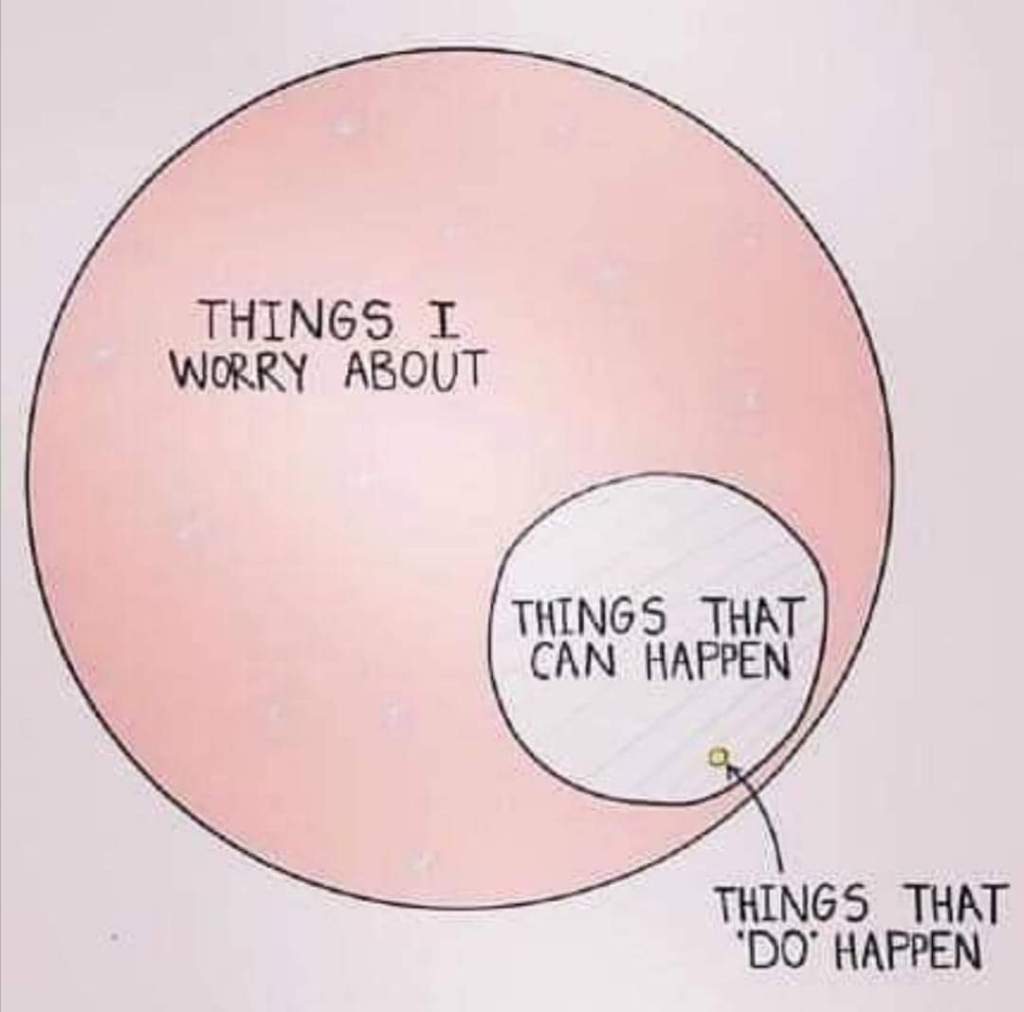
I’m sure if I met you for a chat and asked what you were worrying about, you could string a whole long list of things together. Some would be based on the reality of how you see your current situation, but the majority would come from a perception of what you think might happen.
The image below was shared on social media last week by a few friends and it got me thinking a lot about this. Have a look – does it ring true for you?
We all do it don’t we? And those daily worries are all too good at taking over. Then the more we worry about them, the more we get stuck in an ever downward spiral that can be hard to move out of. I’m also aware that on top of normal things people worry about, the current pandemic has added a whole other layer. So how can we move out of this cycle of worry?
Conquering the cause of worry or anxiety takes time, especially while the symptoms persist. When panic strikes, try these simple tricks to refocus and calm down:
Reset your mind by focusing on another sensation, like the feel of the ground under your feet.
Ask yourself if your negative thoughts are rational.
Breathe deeply, starting at the bottom of your stomach.
Find a quiet space and talk to yourself, using calming and encouraging words.
You can also try this very simple mindset shift as highlighted in the short video below from Simon Sinek.
So here’s your challenge: Change your mindset. Turn the negative into a positive. Turn the worry into excitement. Turn your fear into hope.
As well as following at least some of what has been shared here, coaching can also help you. It won’t give you the answers. But it will help you to ask yourself the right questions that will lead to the answers. It’s about being helped to be the author of your own future. Sounds good right? Why not jump on the waiting list for our free coaching programme right here. What are you waiting for?
In this week’s Community Safety Blog, I want to reflect upon community decision making and how as a model of active citizenship it can impact positively on all decision-making structures right up to national policy making in government. I have been reading the recently published Citizens Assembly Summary Report and as a model for involving ordinary people with the big issues of the day it has much to offer the practices of community empowerment. Citizens assemblies are new to Scotland, but they have been used successfully in many other nations, Australia, Canada France, Belgium, Poland and most recently the citizens’ assembly in the Republic of Ireland looked at issues including abortion, equal marriage and the opportunities and challenges of an ageing population.
Here are some very brief highlights lifted from our Scottish report:
6.
“The Citizens’ Assembly recommends that in order to
ensure that citizens can make informed decisions in
relation to rebuilding their communities the Scottish
Government and Parliament should:
establish community-based citizens’ assemblies
to assess what is happening in our communities
(including the effects of COVID-19), identify gaps
and recommend actions, including through digital
technology, that can bring people together and make
our communities more inclusive.
In my view this would work well in Camelon and Tamfourhill, it encourages localism and will ensure responses and activities really are appropriate to the needs and aspirations of local people. A local community -based citizens assembly of anywhere between 30 -100 members, they could be picked randomly within agreed demographics to ensure they are representative of the entire population and inclusive of all interests. I have a priority to support the formation of a community safety group for our local areas and this could easily be formed as an Assembly subgroup or community safety could be a key agenda item or theme for consideration by the wider assembly. There is no reason why individuals could not be requested to participate on a similar basis as being called for jury duty, it could be treated as being a part of your responsibilities as a citizen, time of work would be guaranteed and of course a payment made to all Panel members. Alternatively, we could operate the Assembly in evenings or weekends and gift people for their time and participation.
37.
The Citizens’ Assembly recommends that in order to
overcome the challenges in relation to young people’s
health and wellbeing the Scottish Government and
Parliament should:
invest in and provide opportunities for all young people
to access extra-curricular activities, including sports
and the arts, with support and guidance for young
people to pursue opportunities that are right for them.
Through this national recommendation Young people can thus benefit though the provision of new leisure and creative opportunities, National government are now required to take notice and act upon this decision as agreed by the Assembly. Locally then this would operate along similar lines in Camelon and Tamfourhill, where Falkirk council, Local Community organisations and Statutory Agencies would be required to respond to the decisions reached by our own local Assembly.
I thought that was a particularly relevant recommendation:
55.
The Citizens’ Assembly recommends that in order
to overcome the challenges in relation to providing
equal internet access to all the Scottish Government
and Parliament should:
invest in infrastructure (and utilise existing
infrastructure) to widen mobile networks and remove
black spots, ensuring all communities have access
to the internet through free community hot spots
and publicly available hardware. Internet should be
considered as a basic need, free to all.
This really will address digital exclusion and providing a free phone service, especially for our elderly population would be a significant positive step to combatting social isolation and improving access to vital services.
59.
The Citizens’ Assembly recommends that in order
to ensure that citizens can make informed decisions
in relation to criminal justice reform the Scottish
Government and Parliament should:
undertake a full review of the criminal justice system
to improve outcomes for communities, offenders
and victims. This would include the reintroduction of
community policing, involving citizens in improving
local communications and services.
This could provide a big change to how we deal with criminality and anti-social behaviour and would work well in tandem with more restorative forms of justice and in directly involving the community with resolving the harm that has been done and remedying injustice in a smarter way. This is another area where a local citizens assembly could deliver big changes for the community.
The full Scotland Citizens Assembly report can be found here:
Dan our Community Coach recently in his blog was discussing free money and the Community choices programme, and this is another example of community decision making and an approach to improving grassroots and community democracy through participatory budgeting. We know about the role of community councils but there are other ways where we can enrich and extend local democracy. Oliver Escobar in his recent essay on the Futures in Common (Scotland after the Virus Gerry Hassan & Simon Barrow) discusses democratic innovations and describes processes where big policy-making decisions are conducted and made directly by citizens and not representatives or elected politicians. He lists: Mini-Publics (community assemblies), participatory budgeting (Community choices) and digital crowd sourcing (online decision making) He promotes the idea of Social commons, and this is a radical interpretation of models of community ownership, it has its origins in the common pastures and common lands that everybody once inhabited, enjoyed and utilised. These shared commons were in fact lands and resources held in common a form of community-based governance. We already have local community groups moving in the direction of asset transfers and taking back into community control buildings and facilities and this can be extended into parks and open spaces, canal towpaths, shops, and cafes. This is all about local democracy and community ownership and as we move towards COVID recovery and rebuilding aspects of our communities then this new democratic thinking provides a route map towards a more inclusive citizenship whilst encouraging greater communal responsibility.
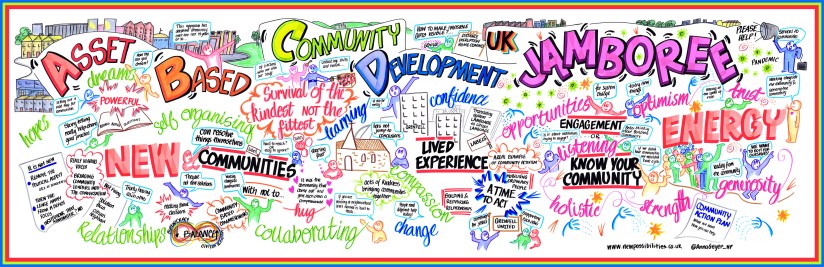
Last week, I was lucky to share a powerful couple of hours on zoom with over 120 other people across the UK who are working with their communities to bring positive change. It was called the Asset Based Community Development Jamboree – hence the ABCD heading to this blog. Don’t get put off with fancy words there – what this really means is strengthening communities with what exists already – i.e. the people. To put it another way, as it says in our mission statement, empowering local people & organisations to bring about positive, lasting change. What this boils down to is a community revolution! It’s the time for communities to build on their own skills and be the authors of their own futures.
I was incredibly fired up from the morning in this session, as I was joined by others who are banging the same drum as I have throughout my time in this role and for years before that: stop doing stuff to communities – work with them. I could write forever on this subject but to save boring you (who said “too late”?!), I will just put this over a series of blogs in the coming weeks and months as the mood takes me and as circumstances dictate.
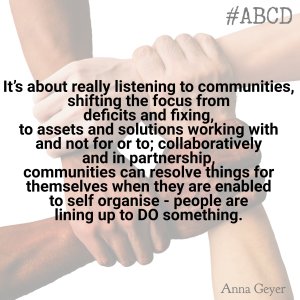
The above image is the graphic notes from the morning, captured by Visual Practitioner Anna Geyer. She has really caught the mood and you can see for yourself that there is so much in there which is why I need a series to bring some of this to a local level. In her twitter summary, this quote really stood out for me:
In every meeting I’ve been in over the last 10 months – especially the current Community Conversations that the Council are leading – I have pressed the point that the whole community needs to be spoken to. Anything dressed up as a conversation cannot fall short and become a place simply for providing information. The people of Camelon and Tamfourhill have some powerful opinions that can really help shape the future of our community. It’s time these opinions were taken seriously and my pledge to you is that I will do what I can to make this happen. But you need to work with me on this.
Back to the ABCD session, below are just some of the comments shared by participants that I managed to capture and feel are relevant to us here. The first 5 quotes come from Fatima El Guenuni, a family therapist in the Grenfell area of London who had family members in the tower that burned down (thankfully they survived). Her talk certainly set the tone for the day:
Communities have never been hard to reach, but they have been easy to ignore.
Voice is important at the centre of communities but action is more important.
Work alongside people and be brave enough to make decisions that benefit the community and not the system.
It’s the system that marginalises communities, not communities that make themselves hard to reach.
We need to be willing to step outside roles & be there for communities with love and support – a hug of compassion and humanity.
Be the “human bridge” between people and the community and the system.
It is time to stop the politicisation of community development.
This citizen centred movement is gathering massive momentum. I hope councils learn, recognise it & work generously with communities to share power & space.
We are hearing of rooted acts of kindness, and the tremendous steely courage of communities, to flourish forward fairly, whatever the challenges may be.
Stories are so important and then stimulating them with the right questions.
Inequalities have driven the change. Our aim was to listen. Serve the people. Unlock skills and talents. Change power.
We need jargon free community development. It’s about people. Local people. Leading local change.
There are so many more that I’ll save for another blog. But can you pick up the themes here? Are you excited by it? Everyone was completely on board with this revolution. This last year has actually been a defining moment for communities across the land, as many have really stepped up to meet their own needs. The challenge now is to build on that, with appropriate support and empowerment, to make this change in power permanent.
I’ll finish this week where I started, with the letters ABCD, standing for Asset Based Community Development. For a bit of fun following a challenge by a Community Builder from the Denny area, I extended this for the whole alphabet, so our A to Z of Community Development is now: Asset Based Community Driven Efforts For Growing Hope, Increasing Joy, Keeping Lives Motivated, Nurturing Others, Persevering, Quickly Reaffirming, Strengthening Talents, Unleashing Volunteers With eXtra Youthful Zest.
So who’s up for joining in on this community revolution? Let’s hear your voices – your comments, concerns, suggestions, hopes, plans. What do you need to help take you forward? Is it other people? Money? Training? Property? Equipment? Other resources? Let us know and we can then work with you to try to make it happen.
The forces of the Pandemic are never far from our daily lives, I do not go with the mantra that we are all in this together, but we are certainly all in the same storm, however some of us are better equipped and indeed better resourced than others to deal with this tempest. Existing health inequalities and disadvantage of Place make the pandemic far more dangerous to some areas than others and when you consider that the likelihood of job losses are far higher amongst the younger, part time and female workers then we certainly are not all in this together.
KODAK Digital Still Camera
“The evidence is that the (COVID) crises has increased the gap between the haves and have-nots and laid bare the fragility of social and economic mores. If wealth is the greatest shield from infection and serious illness, then disadvantaged communities are the most exposed” (Scotland’s Urban Regeneration Forum 2020)
Within this prism of inequality, we have our younger people who have had to suffer a breakdown in their peer networks of friends and mutual support and where their social and academic learning has been badly disrupted and consequently there has been a marked deterioration in their mental health and spiritual wellbeing. We know this will end and there will be a route map out of these circumstances, inevitably some pain and negativity will be residual and its therefore crucial that we ensure young people and children have ample opportunity to reengage with their friends and peers and ensure their social spaces, especially in the outdoor environment are recognised, protected, and substantiated.Within this context I was drawn to a recent collaboration involving Outward bounds Scotland, Scottish Scouts and an array of youth work agencies called “A vision for young people” and where Moillie Hughes, Scouts Scotland President and Record-Breaking Adventurer said: “At a time where the lives of young people have been shaped by staying at home to protect their communities, it is crucial that we create future opportunities that give them a chance to spread their wings, foster confidence, and resilience, build new friendships and develop an attachment and respect for nature. This is unachievable in any other environment.” The cry is for greater outdoor learning and an acknowledgment of the healing power of the outdoors, the plethora of opportunities that young people can benefit from through engaging with their outdoor environment and where they can recapture a sense of wildness and freedom uniquely gained from unstructured and unsupervised play in the great outdoors.
“When I heard the storm and looked out, I made haste to joint it” John Muir
You may ask what is the link to our community safety priorities? If we consider the landscape of our outdoor parks, open spaces, and common grounds in Tamfourhill and Camelon and then ask, are they safe and conducive to allowing our children and young people to explore, take calculated risks and bond with their peers and allow them to affirm with the natural world, and if the answer is, they are not, then they must be a local community safety concern. This is echoed in the community safety survey and has been highlighted in Focus groups and with some of the agencies that I have met with, rubbish, fly tipping, detritus, drug use and Anti-social behaviour have all been sited as reasons why our open spaces and common grounds might not be considered safe. Another historical factor at play here has been the steady erosion of available open spaces for children to play. In Scotland since the industrial revolution children have one ninth of the roaming room they had in earlier generations. Childhood is losing its ancient commons of woodlands, parks, and heaths and with the modern fixation with using technology, devices and computer screens that alienation from the natural outdoor world has been further accentuated. Play for children has become enclosed indoors whilst outdoors signs and messaging bark at children like vicious guard dogs: NO CYCLING, NO SKATEBOARDING, NO BALL GAMES, NO SWIMMING, PRIVATE KEEP OUT!!!!
In the months ahead it makes considerable sense to be encouraging greater outdoor experiences, for us all, but especially for our children and young people. I know ther will be genuine concerns that leaving children unsupervised in open and wild spaces is far to risky and increases stress levels for parents and family members. It would however be legitimate to ask the question the other way around, can we afford not to allow and encourage this in the post COVID world? There is a balancing act required but for certain the wellbeing and mental recovery of children and young people must be the critical and determining factor. The safety of our open spaces must be a local community safety priority.
“As part of a wider recovery process, children should be encouraged and supported to spend time outdoors, playing with other children and being physically active,” say Play First UK. “This is not an either-or decision. Social connection and play offer myriad learning opportunities and are positively associated with children’s academic attainment and literacy.”
We all have a story to tell don’t we? The difference is what kind of story it is. Does it tell of a life where everything has gone fine for you with no issues? Does it tell of a battle against everything that life has thrown at you over the years? Or is it somewhere in the middle?
Wherever your story lands in that range, it is equally important because it’s about who you are, where you’ve been and hopefully what you’ve learned along the way. All of that can help you understand more about yourself and help you move forwards, but it’s also important to capture these stories as part of the ongoing history of our area. When people hear or read them, they may not be surprised at some parts but the joy is when you can surprise them with tales of positivity in spite of everything that has been thrown at you.
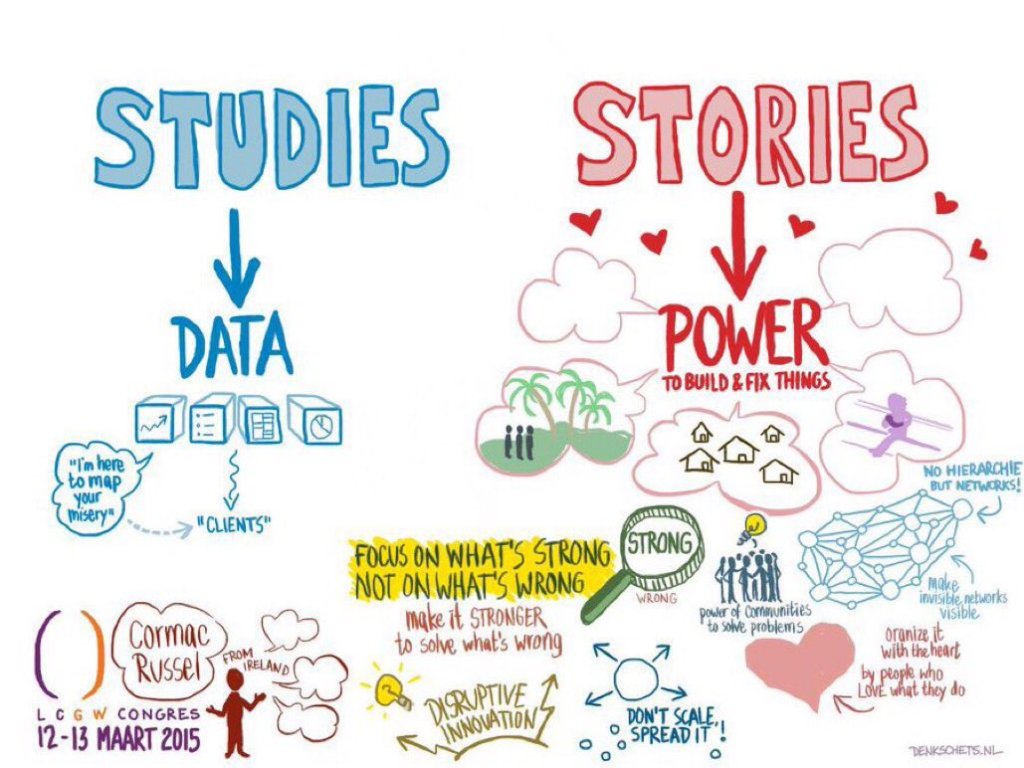
The image below was shared on twitter recently. It is an image of notes captured from a talk given at a conference a few years back by Cormac Russell, who is a leading force in the world of Community Development especially when it is focussed on building upon the assets (the people etc) within those communities. I am learning loads from his writings as he speaks so much sense about not over complicating our work with communities. (You can follow him on Twitter here). The key word in that last sentence – as I’ve emphasised from the start of my work here – is ‘with’. We at OPCT are not here to do things to you or without you as has happened in many cases in the past. We are here to work alongside you and with you and as part of that, we love hearing and learning from your stories. Have a look at the image and see what jumps out for you:
So what did you spot in there? Feel free to message me with any key points especially if you want more information or even to push a particular line for something we should be doing better. For me, the following stood out.
Studies or Stories. This was the headline from the talk and is worth highlighting and clarifying. In one sense, both are important. I’ve already said how much we love stories and there is so much to be learned from them. However, each story is one person’s viewpoint and it is highly likely that there will be another story that will give a completely different view of a similar situation. So with that in mind, studies also have an importance because that gives us an overview of all points of view in a coordinated way. This is why we have already carried out a few surveys – not just to gather more data for the sake of it, but to help us understand what people want, what can be done to move things forward and to use it to make changes and access funding. We are determined to not let any of the consultations sit idly on a shelf with no action. Neither are we going to use them simply to point out what is wrong in the area. All findings from the studies will be used to ensure the stories we tell in the future will be ones of action and positive steps forward. How great would it be for someone in years to come to tell a story of how they made a comment in a study that led to a positive change right here? That’s our wish so please stick with us when we do a survey and feel free to remind us that there needs to be action in the end.
Focus on what’s strong not on what’s wrong. This is so important. I’ve mentioned this in previous blogs and have been accused by some people of ignoring the problems around us by only looking at the good stuff. Nothing could be further from the truth. Yes there are issues and yes they need sorting. No one is denying that. But we are not going to be weighed down by them or avoid any opportunity to grow because they exist. We solve them best by building up what is good – what is strong – what is positive – so that in part, we can tackle what is wrong head on because we have the chance to show people a better way.
No hierarchies but networks. This is about bringing everyone along on the journey (forgive my use of that word!). It’s not about building up committees but communities. Yes, there will be people that need to step up to lead and coordinate things, but the clue in the meaning of the word ‘lead’ is that they bring others along with them – networks of people with a good mix of skills relevant to each project or activity. This is not about raising up just a few people, but everyone who wants to come along for the ride. And within that, we will work with everyone at their individual level to help them gain the skills they need to strengthen their part in the network.
Power of communities to solve problems. You might have missed this one as it’s quite small on the image but I don’t think this represents the strength of the statement. Camelon and Tamfourhill is an amazing community made up of smaller communities that are full of people who have a passion to grow the community they live in. That combined positive passion is where the power comes from. And it’s a power that should never be underestimated by others as it is built on real experiences and real understanding of what makes this community really tick. And as I mentioned earlier on in this blog, that power can and will solve the problems that we face.
I could go on but I won’t bore you any further – for now! Just know that this is really important to me as your Community Coach – as a local resident – and even just as a fellow human being! I believe that everyone has the right to achieve their potential and want to do all I can to help in that goal.
We will no doubt return to this matter again but I want to just focus on the aspect of story telling as I finish off for this week. You have a unique opportunity to tell your story in a written format, and if you want, to have that shared as part of a book that will celebrate this area. That comes via our Creative Writing Introduction Course with the help of Kev McPhee, Susan Marshall and Camelon Arts. We’ve had a great response to this so far but there is still room for a few more to sign up. Join us and be part of something special. All information at www.opcamelontamfourhill.co.uk/creativewriting.
Until next week, keep making and sharing stories and building local power.
I attended last week’s Forth Valley Third Sector conference and was extremely impressed by the dynamic and versatile nature of our thriving voluntary sector. I have been away from working full time in the sector since 2006 and it was therefore a rewarding experience to be amongst my colleagues form across Forth Valley in common cause and to hear first-hand about the successes and aspirations for the sector. There was a keynote speech from the Cabinet Secretary for Communities and Local Government Aileen Campbell MSP, who clearly is a champion of the sector and it was heartening to hear her acknowledgment of the absolutely critical role that the sector has played in supporting communities through the COVID crises. She characterised a sector with no logos, no egos and no silos which has worked with care and compassion right at the core of the community and supported services from befriending, connecting with the lonely and isolated and provided food and welfare to the most vulnerable within our communities. This action had more widely demonstrated what can be achieved when communities are empowered, and bureaucracy is stripped away. The third sector will be critical to the wellbeing and future of our communities as we recover and rebuild post COVID, our communities will be strengthened by this continuing support, dedication, and skills of the sector. There was however an understanding that the sector must have full an equal parity when governments make strategic decisions about funding and policy priorities and this was acknowledged as an area that can improve and that to not facilitate this would be to miss a real trick. The third sector is thus a key player in the National Performance Framework. On a similar theme the need for sustainable funding and the avoidance of sudden ends to funds and the timescales for renewed funding were all areas that could be improved for the third sector and therefore for local communities.
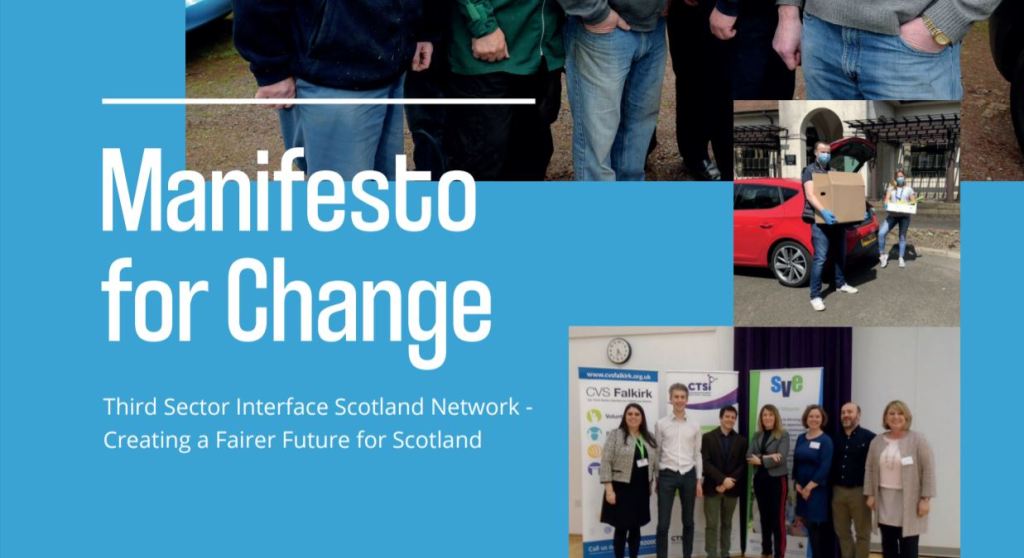
The conference was used to highlight the new Third sector national strategy: The Manifesto for Change, and it cannot be emphasised enough that post COVID Scotland will be reliant upon these manifesto recommendations being acted upon and implemented in full. Here ae the key recommendations:
The TSI Scotland Network calls for:
Place: A decisive shift of emphasis and resources to help support and ensure community delivery of place – based services where the wellbeing of people , places and the environment come before profit to protect the communities and most vulnerable in our societies.
Community: Increased investment to build capacity and resilience by the TSI Scotland Network to ensure that every community in Scotland maintains robust , representative and resourced community-led organisations or partnerships that serve local needs.
Connected: Clear connection between TSI Scotland Network with Scottish Government directorates to inform the necessary policy changes to ensure implementation of localised place-based strategies for economic renewal.
Volunteering: Recognition that the TSI Scotland Network can make a unique contribution to empower inclusive volunteering and maximise the social and community action that emerged through Covid-19
Fair work: Employment schemes that are linked to community, wealth-building and creating fair, inclusive and sustainable economies, to maximise community benefit, reduce poverty, and inequalities and tackle the climate emergency.
This is a radical agenda and one that builds from community empowerment, local action. and off course Our Place.
Our Place Camelon and Tamfourhill were at the centre of the conference workshops and wider debates, and there was much discussed that was relevant to our own communities and in my case operational direction and examples of good practice which could be suitable for developing community safety initiatives locally. A strong third sector means a strong community; this is so relevant in the world after the pandemic but the response to date offers a glimpse to a thriving and dynamic future for local communities throughout Scotland.
Well if that headline hasn’t grabbed your attention I don’t know what will!
When I’ve put up blogs about funding before, they’ve been mainly directed at organisations and admittedly not relevant to everyone, but this one is different and is worth reading on – I promise!
Falkirk Council have released over £3m of funding that is available for local communities to apply for to bring about the changes that can make a difference in their community. There are different allocations for each local authority ward and ultimately, you, the council tax paying public, will get to vote on which projects get the money. It is released under the banner of “Community Choices” and all the information is on the council website but I’ll summarise the main points for you here.
Before I get into the funding specifics, let me remind you about how the Council Wards are structured. Our work actually covers two Wards, with the Forth and Clyde canal essentially being the dividing line: Camelon is in Ward 6 (Falkirk North) that also includes Langlees, Bainsford, Bankside, Middlefield, Merchiston, West Mains and Grahamston. Tamfourhill is in Ward 7 (Falkirk South) that also includes Bantaskine, Summerford, Arnothill, Woodlands, Callendar Park, Glen Village, Lionthorn and Hallglen. I list all these areas to let you know what you’re up against as every area will feel it deserves its fair share of the funding and will undoubtedly have worthy projects to put forward.
So, do you have an idea that will improve the quality of life in our community? Do you have a proposal that will make a positive and lasting difference to our area? I know of quite a few options and this fund could be the way to make it happen. Essentially, here at OPCT, we will support you as much as possible to help make your application as strong and relevant as it can be. You don’t have to come through us but if you do need assistance, we can help with application wording, background information, or anything else you need. Importantly, we may also know of a project that is similar to what you are thinking about and so could provide relevant advice and, if appropriate, we could link you up to double the strength of your application.
So, who can apply?
Clubs, organisations, community groups and even individuals can apply for funding to make these changes happen. Applicants do not need to have a formal constitution but if you’re an individual or group of friends/residents considering putting a bid in for something, the Community Choices team will aim to link you up with a recognised organisation that could hold the funds for the project.
What can you apply for?
Firstly, let me say that this funding will not solve everything we’d want to do locally and is unlikely to help with large projects – but it’s a start. The public vote system will at least bring visibility to what you want to do which might even attract others to join in with you.
There are two separate funds on offer. The first is a small grants programme with a maximum of £1,500 per proposal. There is around £10,000 for each Council Ward in year 1. The second fund is a Capital programme where £3m is available over two years. Proposals for this fund must be for a minimum of £5,000, and can be used for building something new, improving an asset, and purchasing equipment. Remember that £3m is across all 9 Wards so even though there is no upper limit on application, large projects are unlikely to be successful. However, the Community Choices team will also aim to provide additional support including signposting to other suitable funding if possible.
What do we need to do?
At this stage, the council just require an Expression of Interest form to be completed. This is not a full application and needs a couple of hundred words to explain what the project is, who it would benefit and who would be involved in making it happen. It does not require full financial information but a broad indication of costs would be helpful. The form is on the website.
The important thing to note is that Expressions of Interest are due by Friday 5 March with final applications due by 9 April. This is a very tight timeline but that’s what we have to work with and, with the right support, the right applications can be submitted. The final stage is a public vote that will take place between 26 April and 14 May. We will keep you posted as we hear how that vote will operate.
So, over to you?
What do you think could be applied for? Can I help you get that application in? Get in touch with me (Dan) in the usual way via email to communitycoach@tamfourhilltro.co.uk, call on 07444 873151, or message via social media. Let’s make this happen!
A key theme of the community safety consultation has been Anti-Social Behaviour (ASB), a contentious notion, hard to define, perhaps criminal perhaps a nuisance and a thousand shades of grey in between. I find particular TV programmes anti-social and the attitude of so-called celebrities as ASB, however I do not think that is the where the local communities concerns and priorities are, although reaching a consensus as to what is and what is not ASB and how-to best tackle this is an extremely challenging conundrum. The ASB Act (Scotland )2004 covers an extensive list of areas including the following: Dispersal of groups, the environment, licensed premises, matters relating to housing, excessive noise and the Act gives specific powers to the Police the local council and other agencies to enforce the laws around ASB which can then lead to an array of interventions and sanctions, including issuing ASBOS, Fixed penalty fines, criminal proceedings, parenting orders, and referrals to the Children Panels.
The Anti-Social Behaviour (Scotland) Act 2004 provides the legal definition of antisocial behaviour as:
“A person engages in antisocial behaviour if they act in a manner that causes or is likely to cause alarm and distress or pursues a course of conduct which causes or is likely to cause alarm and distress to at least one person who is not of the same household. (Course of conduct must involve conduct on at least two occasions).”
Antisocial behaviour may include, but is not limited to the following:
noise disturbances, including loud music, noisy parties and shouting.
harassment
hate crimes including race, religion or faith, sexual orientation, disability or transgender or gender identity.
violence or threats of violence
verbal abuse
vandalism and graffiti
drug dealing
The local community safety survey found that 35% of respondents identified ASB as their greatest concern in the local area, the notable issues were groups hanging about, underage drinking, noisy neighbours, vandalism, and fire raising. These behaviours are not pleasant to have to live with and it is therefore important that the local community safety strategy tackles these concerns effectively. Let’s however take a look at the national picture and as I have highlighted in a previous blog Modern Folk Devils and moral Panics: – Our Place Camelon and Tamfourhill (opcamelontamfourhill.co.uk) youth crime and ASB have over the last 10 years been consistently decreasing throughout Scotland. This situation has been noticeable in many aspects of Scottish society, however the communal anxiety about ASB and youth disorder has remained the same in our most disadvantaged communities. The recent published research by Robyn Bailey: The Scottish picture of ASB July 2020 found this to be a significant issue, i.e., although youth crime is steadily reducing those communities most negatively impacted by poverty and inequality still perceive this to be a significant problem. This off course is open to interpretation but perhaps the underlying issue is that there is a lack of opportunities for our young people which makes their behaviours more visible and when the local community lacks the capacity or resources to better engage and support its local young people then the issues are amplified and can appear worse than the actual levels of recorded criminality. This would suggest that if we invest more time and resources into working with our young people and if we similarly build the capacity of our local community to better support and engage with the youngsters then we will achieve positive results and outcomes. I know there is already good quality youth work taking place locally and I have experienced at first hand the community development approach utilised by TCV with their outdoor learning approaches with local young people. Outdoor learning and an appreciation for the environment can be used effectively to build positive relationships with young people and facilitate their personal and social development and instil an increased sense of social responsibility for that environment. Clearly if this approach could be sustained and further built upon then this would have many benefits for both the young people and their wider community. The local safety strategy I believe will be the most effective if it takes a community development and capacity building approach. The skills already exist within the community, the important thing is to build peoples confidence through training, support and investing in their knowledge, skills, and life experiences that they bring with them and which potentially can be deployed for the benefit of the wider community. This is a self-sustaining approach where the community sets a tradition and expectation of running and developing its own provisions, activities and services and these skills and knowledge get passed on through an ongoing programme of peer development. This also can potentially create new employment opportunities which will improve the local economy and address the adverse impacts of poverty and inequality. The community itself requires to build the confidence to deliver its own youth, children, and family work programmes. The exiting success of youth clubs and activities at Tamfourhill where local people have been empowered and built upon their skills to work in partnership with local families, children and young people is an excellent template for further development throughout all our local neighbourhoods.
It is unlikely that increased law enforcement or punitive measures will really have any lasting impact upon the safety and cohesion of the local community. The answers I believe are much more internal and the assets of our communities within their networks of support are the foundation upon which a local community safety strategy should be built.
I know days and dates don’t necessarily mean much at the moment, but apparently we have entered a new month! So it’s as good a time as any to give you a brief update on how some of the projects I’m working on with and for the people of Camelon and Tamfourhill are coming on.
Community Growing We continue to make plans for various growing projects. One particular one in the old Brown Street Park, Camelon, will move to a consultation stage for surrounding residents later this month. We are also about to spend the Community Climate Action Funding received from Keep Scotland Beautiful / The Scottish Government that will see 2 Community Gardening Tool Libraries installed in the area. Those will be in place by the end of March. Keep up to speed with all Growing information, and join our team, over on our dedicated Growing page
Community Supporting I have continued to work with organisations and individuals across the area with various different needs. Next month I will bring you full information of how you can access 1 to 1 coaching sessions to help you make the right choices and bring clarity and confidence to life’s opportunities. It’ll be worth the wait but if you want to get on my list for receiving coaching sessions before I’ve even launched this, then drop me an email at communitycoach@tamfourhilltro.co.uk.
Community Training This is the one that has taken most of my time lately and rightly so. Firstly, I can tease the news that we have partnered with a relatively new local charitable company to bring a wide range of personal development courses to you. More on that later this month but it’s an exciting step forward for us. For now though, let me remind you that we launched our Creative Writing Introductory course last week and have had a good response already. Thanks to those who have signed up but there’s still room for more. I’m also pleased to introduce one of the experts that is supporting this course. It’s Camelon’s own Kev McPhee. And to save me going on about things, here’s a video from Kev to give you a bit more information on the course and to encourage you to get involved. It may be 8 minutes long but it’s worth the watch, especially as he gives away some information about our hopes for those who come on the course! Enjoy this video and I’ll update you with more in due course.
I recently attended the launch of the walking manifesto for Scotland: Walking back Better has been produced through a partnership of Living Streets Scotland, Ramblers Scotland, and Paths for all.
The manifesto wants everyone in Scotland to be able to benefit from everyday walking, whether that is walking to the shops or to school or walking for enjoyment and exercise. Walk Back Better sets out their vision for Scotland to move forward to a healthier, cleaner, safer, and happier walking nation.
It is hoped that the Political Parties will be influenced by this manifesto as we move towards the Holyrood elections and that other stakeholders and agencies will support the key facets of the manifesto and play their part in its realisation especially at local neighbourhood level.
Here are the key aspirations and ambitions of the manifesto:
Investment in a £50m infrastructure fund to develop local walking routes, long distance routes, green neighbourhood networks and support under pressure mountain locations.
Improved walking and wheeling conditions, including reducing pavement clutter, providing toilets, seating, signage, safety improvements, improved crossings and basic path and pavement maintenance.
Improved access to local amenities, ensuring the planning system prioritises and delivers development within walking distance of local facilities as part of the 20-minute neighbourhood agenda.
Increased investment for delivery of walking behaviour change programmes that particularly target the most vulnerable and help to reduce inequalities.
Measures to improve safety, including a national speed limit of 20mph in all cities, towns and villages and enforcement of pavement parking legislation.
Investment in walking to school and reducing traffic and pollution outside school gates.
There are familiar themes in this document, and they are consistent with several aspects of the Camelon and Tamfourhill Community Safety Strategy. Thus, we have a vested interest in seeing many of the highlighted policies and declarations being adopted by government both local and national.
Walking has been a lifeline for people throughout the COVID crises and it is widely acknowledged that walking is the best buy in public health. Walking as a health activity should be accessible to all and off course you do not need any equipment for this outdoor activity so it can play a positive role in addressing health inequalities. The canal towpath, our local parks, and open green spaces in Camelon and Tamfourhill could all benefit through improved and safer access, proper facilities like toilets, seating, and improved lighting. Further Improved design, notice boards, signage and appropriate access for wheelchairs are also a significant aspect to this activity. I was also impressed with the findings of recent research which is being cited to support the manifesto proposals. This work found that when there are people out walking on the streets then there is less anti-social behaviour and a reduction in reported crime. As people are about more then the community and its networks are more visible, quite simply if the community is on the streets then others are far less likely to engage in unhelpful and negative behaviours and people generally then feel much safer. When we are out and about walking then we are encouraged to better network with our neighbours and friends and we do this communally and visibly and, this creates a better sense of connectedness and facilitates improved community cohesion.
Plenty Taxis available
The launch input from Living Streets Scotland emphasised that local communities can and should develop their own responses and projects which are aligned to the manifestos policy priorities. They spoke and promoted community safety projects that had developed around schools. There are far too many cars in Scotland, and they must be reduced, look at any school in the morning and they are overwhelmed with cars, parked cars, moving cars and obstructive cars. The national aspiration of a universal 20mph speed limit and the implementation of pavement parking legislation are all pertinent to our local community safety priorities. The work I am supporting with the Parents Council at Easter Carmuirs Primary School is a good example. The intention there is to get the various statutory agencies on board with developing a school streets scheme and to explore the possibility of securing SUSTRANS Pocket places funding to promote active travel and improve vehicular safety around the school and the surrounding streets. Community speed watch and temporary lockdown measures have been successfully deployed around several schools in the Edinburgh City Council area and I am hoping that Easter Carmuirs could be a first for the Falkirk Local Authority area.
Achieving political commitment to many of these manifesto ambitions will contribute to making our local neighbourhoods safer, happier and a more attractive place to live.




 Safer Communities Youth Action Project