community

The Tidy, Clean and Green Campaign is on tour this Easter

As we approach the Easter holidays, and we anticipate the easing of the COVID restrictions I want to use this week’s community safety blog to highlight a programme of Community safety activities that are scheduled for the next few weeks. The Forth and Clyde Canal from Lock 16 to the Falkirk Wheel will be the focus of two full days of Canal clear up and conservation work and also happening is a series of COVID proofed community litter picks which will all take place as a part of our local Tidy, Clean and Green Campaign.

Lock 16: The centre of this Easters Tidy, Clean and Green activities.

Firstly, through funding that has been awarded by the Falkirk Great Place Project and with the support of Scottish Canals, The Conservation Voluneers and Falkirk Council Waste Services we will be launching the Canal Clear up and conservation Project. Initially this will involve local young people working on the canal over the school holidays, and this will include a water based clear up and a land-based conservation project. The young people will also take part in a workshop on the theme of keeping the community tidy, clean, and green and taking pride in Falkirk.  Every participating young person will have their volunteering rewarded with a Saltire Challenge Award and also by receiving a certificate of achievement from all the organising partner organisations. Central to this Project is to instil a sense of awareness with the young people about the importance of looking after our green spaces and through their own significant contribution to their conservation and improving the litter problems. This will be carried out in a challenging and enjoyable way. New skills will be learnt in watercraft and using paddle boards which will enable all the participants to gain their Paddle Start Award. This has really been a collaboration of a Project and it will continue to run on a monthly basis from May through to August. I will be encouraging local people of all ages and experiences to come and join us for a day’s environmental work on the canal, places will be available for each month and I will advise the local community of how to get involved and book their place by the end of April, so please keep an eye out for this on the Our Place social media and other local forums. Everybody who takes part will have an opportunity to gain certificates for volunteering and several accreditations, they will learn new skills whilst making a positive contribution to their local community.
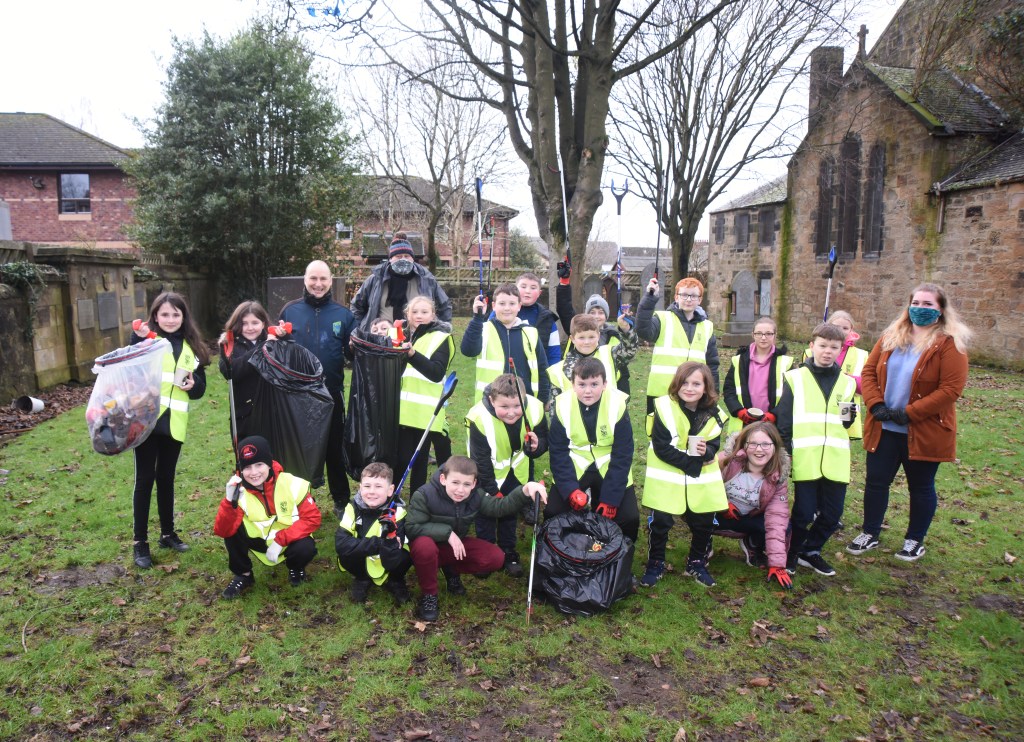
Pupils from Carmuirs Primary School after their litter pick in December 2020

There will be three community litter picks taking place over the holidays and hopefully local people will be able to see a significant improvement to the chosen target areas. I know one of the challenges is keeping areas clean and tidy after they have been cleared, however there are plans to convert some of these bad grot spots into pop up parks and wildflower meadows and this will provide another opportunity for local activity as we move into spring and summer.  I am incredibly pleased to welcome the Addictions, Support and Counselling services Recovery community and the Cyrenians Navigator project who will be leading on two of the community litter picks which is a welcome development and I believe the beginning of a long-term community safety partnership. The third litter pick has been organised by local volunteers and I look forward to supporting them to clear a a particularly bad problem area in Camelon. I would want to point out that these litter picks all comply with COVID guidelines and will be carried out in pairs and will be fully physically distanced, and for these reasons I am unable to involve any additional people to these activities, however come May and onwards I hope that we are able to have a big community litter pick and outdoor activity at least once every calendar month.

The final action that I want to highlight is the new posters and signage that will be going up around the Camelon and Tamfourhill areas, it has a truly clear message and to remind everyone here is the competition wining drawing from Jaimee who is a Primary 7 pupil at Carmuirs Primary School, please keep an eye out for this character appearing on a rubbish bin near you.   

#tidycleangreen

camelon, coach, community, Our Place, resilience, Support, tamfourhill

What does ‘success’ mean to you?

Community Coach Blog, Dan Rous, 25 March 2021

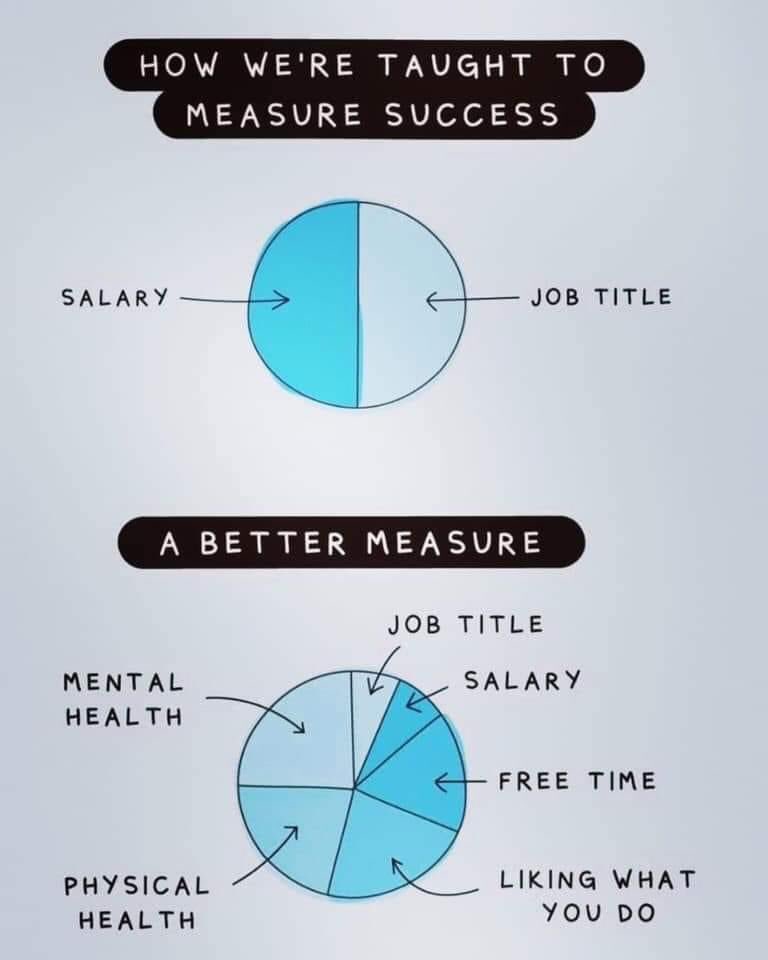
I saw this image on social media and thought it deserved a feature in this blog. Have a look at all of it and then we’ll discuss a bit further

So what does success look like for you? Or maybe I should ask what you’ve been told that success should be for you.

If this last year has taught us anything, it’s that there is more to life than just work. Many people have realised that they’ve neglected the most important things in life so that they can climb the career ladder and have suffered as a result. Now let me stress here that there is nothing wrong with climbing that career ladder. If that’s for you then you go for it (please remember us when you’re successful!) But even when doing that, it is important – I’d even say crucial – to make sure you look after yourself on that journey. And by “yourself”, as the chart above shows, I mean your physical AND mental health.

Before I carry on, have a watch of the short video below in which some people are asked how they would define success:

Surprised by some of the comments there? What was the standout? I can’t help be reminded of the guy who wanted the most likes on Instagram and wonder what kind of success that is! But really, the person who stood out was the man who said coming home from work to see the smiles on his families faces was his measure of success. I love love love that! He felt good about his work and even more happy when he was with his family. I’d say that’s a perfect balance – wouldn’t you?

So how do we get this for ourselves? Let’s go back to the image we started with, and to help, I’ve guestimated the percentages for each section:

  • 10% Job Title
  • 10% Salary
  • 15% Free Time
  • 20% Liking what you do
  • 20% Physical Health
  • 25% Mental Health

So whether you learn better from a picture or from numbers and words, this seems to make it clear doesn’t it? First and foremost, focus on your mental health. The salary and job title are the least important things. Within that mental health section will be having good support networks around you whether that be family or friends. Surround yourself – online as well as offline – with people who can bring genuine support and positivity. Keep yourself as active as possible within your own capabilities and obviously just now, within allowed limits. And notice this – liking what you do is as important as the job title and salary put together. Also, having free time is not far behind liking what you do. Down time. Switching off. These are so important to help both your mental and physical health.

Now let me say something here before those who know me well start having a go. This blog falls very much into the territory of ‘do as I say not as I do’! I’m really good at talking about the theory of things like this but not always so good at putting them into practice. If I’m honest, right now I’m doing well with the ‘liking what you do’ bit and I certainly don’t care too much about the salary. My mental health is mostly okay, and physically – well let’s move on!

So, shall we work on this together? As community, can we agree to help each other with this quest to redefine success. It’s not dumbing down success. It’s making it more real, more sustainable, more enjoyable, more successful!

As always, if you want to make any suggestions, or just chat anything through, give me a shout. communitycoach@tamfourhilltro.co.uk or 07444 873151.

Finally, remember to keep Monday 26 April, 6:30-8pm, free in your diaries. All will be revealed soon!

community

‘Any fool can destroy trees. They cannot run away … God has cared for these trees, saved them from draught, disease, avalanches … but he cannot save them from fools’

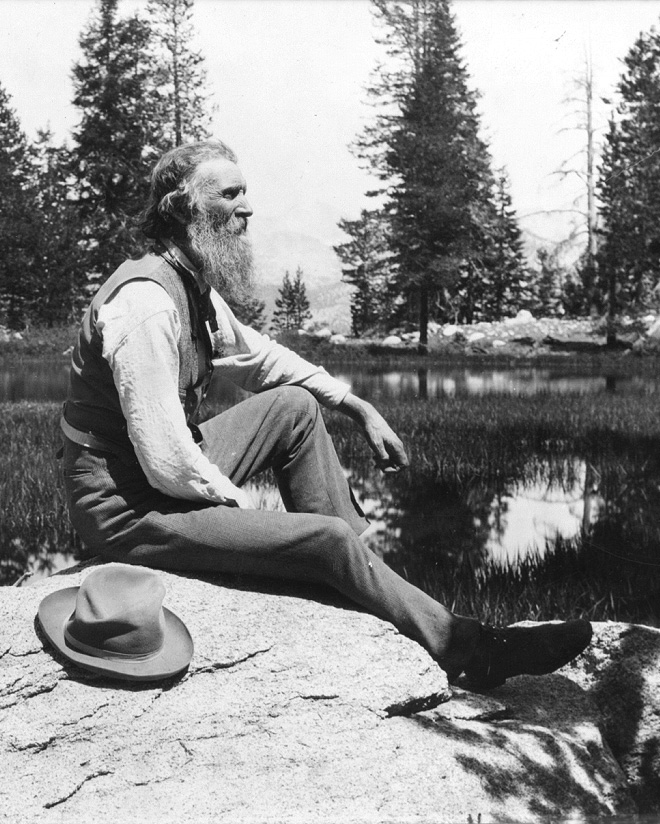
John Muir Son of Scotland, born in Dunbar, father of the American National Parks and probably the world’s first conservationist and ecological campaigner.  The centenary of Johns death was in 2014 when the John Muir Way was opened to mark that anniversary, the walkway goes close by as it travels through Falkirk at https://johnmuirway.org/route/kilsyth-falkirk/ and then onto the next stage at https://johnmuirway.org/route/falkirk-linlithgow

John Muir Pondering on a rock

A quick resume of his childhood takes us onto the beaches of south east Scotland, Dunbar castle and playing high risk dares with his younger brother David. Fathered by a strict disciplinarian lay preacher and facing terrible brutality on a daily basis, John nevertheless developed a spiritual closeness to nature and all things wild.  He was not a great school pupil and was often getting into trouble with the class teacher, skiving off his class work to go on adventures looking for birds’ nests, animals, and rock pools and he is on record as saying, “Dunbar was my teacher”. Years later he was awarded a university degree and was hailed as a genius by many in the USA and certainly by President Roosevelt who responded to John Muirs expeditions and political campaigning by ensuring that the National Parks were established in America and have continued to thrive and develop as a core aspect of American life and culture. Muir knew that we could not take nature for granted and that as human beings we had a responsibility to look after every living thing, our human existence and the natural world were totally intertwined in an absolute whole.   

The Muirs emigrated to Wisconsin in America when John was 10 years old and its somewhat ironic that the father of the American National Parks would not have seen a national park established in his home country of Scotland until 2002 when the Loch Lomond and Trossachs National Park opened. His biggest realisation was that the trees and forests were the lungs of the world, our source of oxygen and hence the air we breathe. He was a prolific writer and campaigner for the protection of those trees and forests and he demanded their protection from man’s continuous destruction of them for profit. Remember that he was writing and campaigning about these issues over 150 years ago and it is a sad indictment on our lack of vision, action and ongoing abuse of our environment when we declare have to declare in 2021 a worldwide climate emergency.

“I have never seen an unhappy tree”

The keep Camelon and Tamfourhill Tidy, Clean & Green campaign can embrace the spirit of John Muir in two interrelated ways, firstly by looking after our local Green spaces and actively improving and restoring them and secondly through encouraging local people to volunteer in local projects whilst undertaking their own John Muir Award.  

The John Muir Trust was established in 1983 with a view to connecting, protecting, restoring and rewilding land for the common good. “Alongside communities nationwide, we connect people with wild places, campaign to protect those places, and restore and rewild land for the common good.” A key feature then is to work with communities, a theme that myself and Dan touch upon with regularity, the Trust cares for over 600,000 acres of wild land, the vast majority in Scotland and the Trust works with communities to conserve and improve this land. The Trust also supports and coordinates the John Muir Award, which is made up of 4 distinct sections, Discover, Explore, Conserve, and share your experiences about a wild place. A wild place could be a garden, a bit of waste ground, Easter Carmuirs Park, the Forth and Clyde Canal or the woodland around Antoine’s wall, it could even be the old coffin alley that links Brown Street with Glasgow Road in Carmuirs. Anywhere you decide is your wild place counts and then you can carry out your own John Muir Award. There are three levels of Award: The Discovery Award, The Explorers Award and the Conservers Award and each Award will involve you taking part in longer periods of time with more detailed involvement with each of the four sections.  I hope that we can use the John Muir Discovery Award locally and that volunteers, community groups, local schools, families, and individuals can all do a John Muir Award and get themselves a nationally recognised certificate whilst contributing to keeping Camelon and Tamfourhill Tidy, Clean & Green.

You can find out all about the Award here: https://www.johnmuirtrust.org/john-muir-award

There will be opportunities in the near future for local people to start their own John Muir Awards. Firstly, there will be ongoing canal clear ups taking place, initially for young people during the Easter school holidays but thereafter there will be monthly Canal clear ups from May through to August, and I will be looking to support any individuals or local groups that would like to get involved with these clear ups to potentially develop this involvement as part of their own John Muir Award. These Canal clear ups have been supported through funding awarded by the Greater Places Falkirk National Lottery Heritage Project and the active inputs of TCV and Scottish canals. My recent discussions with the Addictions Support Counselling Recovery community and the Cyrenians Navigator Project have agreed that we would offer opportunities for their local volunteers to participate with conservation and outdoor work and this again will provide an ideal opportunity for those volunteers to undertake their own John Muir Award. This is part of the developing Community Safety strategy and will be in align with several of that strategies key outcomes, especially around improving our local green environment, supporting the community’s capacity to address ASB and provide additional opportunities for those in recovery to gain training and qualifications through volunteering.

More information about the John Muir Trust can be found here: https://www.johnmuirtrust.org/john-muir-award

And of possible interest is my own experiences of the River Devon Valley and my journey of exploration with John Muir:

https://www.jhosiesite.wordpress.com/

‘When a man plants a tree, he plants himself. Every root is an anchor, over which he rests with grateful interest, and becomes sufficiently calm to feel the joy of living.’

camelon, coach, community, development, leadership, Our Place, resilience, Support, tamfourhill, training

IRTDMN part 2

Hi – it’s Dan back again! Welcome to part 2 of our look at this strange word that actually stands for 6 different words which in turn help us in looking at Launching Leaders. In last week’s blog we identified the first three words: Identify, Recruit, Train. Have a look back at that blog to remind you of the detail behind those elements, but as an addition to what I wrote then, a key part across those three is the reasoning behind why you’re launching a new leader: never recruit from a need. What do I mean by that? Well it actually takes us back to an even earlier blog I wrote on the theme of “Start with Why“. If you’re just looking for someone to fill a gap, you might not get the person you actually need. You need a person who has a natural fit to your requirements and that is only discovered by asking why you need that role filled. What is the vision for your project/task/organisation/plan? Michael Gatlin says that “the currency of recruitment is vision” so go back to why you’re doing what you’re doing, then Identify, Recruit and Train someone from that point. ‘Selling’ the vision to someone will give them more of an idea of what’s ahead rather than just begging for them to get involved!

Okay, we’ve had our recap from last week, let’s get going with the next 3 words.

First up this week, the D is for Deploy.

This is important but is also tricky, because knowing when to deploy someone fully into a role on their own depends on the person! Michael Gatlin says this is “more of an art than a science” and won’t work every time. That may not sound very helpful in the grand scheme of things however he goes on to say that “the best time [to deploy them] is when they still have things to learn so that they are not unduly confident”. A key point here is that whoever you deploy will still need support. Deployment doesn’t pass the buck. Without interfering, you will still need to be around for them. Whether that’s providing an important insight, a key contact, or just a sounding board – it is all really important in the whole IRTDMN process and actually, leads us nicely onto the next letter.

So next up, the M is for Monitor.

This is not a kind of big brother type eaves dropping, but a managed evaluation and support of them. Look at it in terms of checking in with them to keep them healthy or if your want a soundbite, try this one: “you don’t get what you expect, you get what you inspect.”

The person you have identified, recruited, trained and deployed, will need some accountability because this will increase their personal resilience to whatever the role will throw at them, and also build their effectiveness in that role. So set clear parameters for them to work within and help them along the way. How exactly do you help them? Let’s check the next letter!

Our final section then brings us to N which is for Nurture.

You want this person to succeed – I mean, you wouldn’t have brought them through the whole IRTDM parts to now watch them fail at N! To truly help them grow as a leader, there needs to be an environment that fosters that feeling. A set up that only wants the best for them in the role.

It’s important to pick up on what leads them to really flourish in their tasks and also, what drains the very life from them! You won’t be able to shield them from those draining tasks – and neither should you – but you can maybe focus your nurturing support on those areas. Nurturing is so important. Because in order for you to be able to move on to whatever it is you’re moving on to, you need to know that the person you’ve IRTDMN’d is actually going to be able to carry on with the very thing you need to let go of.

Let me summarise. Through the I and R stages, you connect with the other person. Through the T and D stages you release them. Then through the M and N stages you stay connected but always pointing them towards the goal. Through it all, be genuine. Know your stuff. Share what you know. And never ever feel bad about asking someone to rearrange their lives to fulfil what they were put on this earth to do.

I love this process and in some way or another have been doing it for many years. I hope it is helpful to you in your setting. I’m also fully aware that if I’m talking with you now, you may be wondering what I’m Identifying and Recruiting you for! Well, guilty as charged!!

If you’d like to chat more about this, then don’t hesitate to give me (Dan) a shout on communitycoach@tamfourhilltro.co.uk or phone 07444 873151.

Credit to Michael Gatlin, Launching Leaders, Vineyard Training and subsequent webinar for the basis of this training.

community

A manifesto for safer communities: March 2021

The Scottish Community Safety Network’s ambition is that Community

Safety is valued and integrated across all relevant policy areas.

We are committed to working to achieve a fairer and more equal

Scotland.

Partnerships & working together will make our communities safer

It is abundantly clear that we have a Scottish General Election just around the corner, it will be a campaign like no other as hustings if they take place at all are likely to be virtual and public engagement is going to be extremely difficult and challenging. I really hope that this election campaign is not reduced to social media and the tabloid press as both platforms often shed more heat onto issues than any light or increased understanding.

Communities have many priorities and as I am writing up an interim community safety strategy for Camelon and Tamfourhill I am very conscious of an array of manifestos that are being published and all with the absolute and honourable intention of influencing the Political Parties in the run up to May’s election. In recent Blogs I have highlighted the Third Sector and their Manifesto for Change and the Walk Back Better from Paths for All and Ramblers Scotland both of immense local relevance. The manifesto of greatest importance however for community safety, and which will have a significant impact upon our local strategy, is the Scottish Community Safety Networks (SCSN) Manifesto for Safer Communities.  Although our local strategy and priorities will be a community led plan and will represent the voice of local people, we also have to acknowledge the wider national context that we operate within and be aware of the central driving forces of the main partners that we will be working with in the coming months.  

Let us consider the key features of the SCSN manifesto and clarify what this will mean locally for the communities of Camelon and Tamfourhill:

  • Poverty: Within Camelon and Tamfourhill we have 3 areas within the 5% poorest of the Social Index of Multiple Deprivation in Scotland, that is unacceptable, and we know that inequality impacts upon our community’s health, life opportunities and performance at school. The manifesto states:  The SCSN would like a commitment to a Universal Basic Income, thus ensuring people have more money in their pockets, Cross sector action on eradicating poverty and a continual dialogue about the harms caused by poverty.
  • Community Safety: This is a biggie for the Our Place Camelon and Tamfourhill Community Safety Strategy: The SCSN believes that communities will be safer if there is more involvement of people in communities in the planning, delivery, and development of the services that they use, they go onto stress the fundamental importance of youth work and Community Learning & Development and an emphasise upon working together through creating local partnerships which keep communities safe. This then will be the guiding principle of our local community safety strategy, it will promote community development and the local ownership of new projects and initiatives, especially with young people and the development of new local youth work opportunities.
  • Crime and Justice: There is a call for a system based on rehabilitation and more evidence-based approaches to reducing crime. Key recommendations include: a request to further raise the age of criminal responsibility, decreasing the prison population and increasing confidence in community justice, early interventions, and a topic I have raised in recent weeks: the decriminalisation of drug use. Locally this will be reflected through prioritising the development of new Recovery services and breaking down social barriers whilst reducing the stigmatisation for those who have been touched by the criminal justice system.
  • Unintentional harm and Injury: An increased focus on Home Safety, delivering more safe and affordable housing, highlighting a commitment to making roads safer and in particular 20 mph speed limits in all built up areas and a strong belief in place-based approaches in built environments. Locally we will work towards lower traffic neighbourhoods and in this respect, we are already developing work with a local Parent Council to develop- and resource a local pocket places safer school streets project.
  • Community resilience and Participation: We believe that communities that have a sense of belonging, connection and control are safer communities. The manifesto promotes a trauma informed approach, encourages a commitment to increasing community participation, including the expansion of participatory budgeting, or community choices as it is described by Falkirk Council. Our Place recently supported local people to make a submission to the Community choices programme as part of the wider; Tidy, Clean and Green campaign and in particular to further the development of local pop-up parks.
  • And Finally: In concluding the manifesto refers to a world beyond COVID where there are new opportunities in a society with increased kindness & compassion, zero tolerance of hatred and an increased focus on Human Rights and the incorporation of the UNCRC across policy and practice.

This is the wider context that our local community safety strategy will be placed within, it will be a very much local affair but one that draws strength and clarity of purpose from these manifesto aspirations, a final thought, are our would-be MSP’s listening to these aspirations for a fairer and more equal Scotland?

The full manifesto can be found at:  

camelon, coach, community, development, leadership, Our Place, Support, tamfourhill, training

IRTDMN

No I haven’t fallen asleep on the keyboard and neither am I making up words again! These letters each stand for a word that has come up in some other training I’m doing. The theme of the training was ‘Launching Leaders’ and it fits wonderfully with my task to uncover the next generation of leaders and community engagers right here in Camelon and Tamfourhill. It gave so much insight especially in respect of working with groups of people and how you help individuals grow. It also involves looking at leadership differently. It is thought that leadership is not a gift for an individual, but a gift for the community/organisation through the individual. This then becomes about identifying leaders within a community, for a community.

So, to this IRTDMN thing. There’s a lot to unpack in these 6 letters/words so I’ll take 2 weeks to cover this to save having a really lengthy blog post.

First up, the I is for Identify.

This is the point where we start to build relationships by getting to know people. That is the best way to start because only with a working relationship with them can you start to identify what they can have the potential to get involved in. Crucially, as the inner potential becomes clear, it is not my role to tell people what to do, but to help them discover it for themselves and walk alongside them as they make that journey.

It is said that a true leader is not one who passes decrees, but who lives and walks with others. This makes so much sense but involves dropping the idea of a true leader as being like the traditional view of a Chief Exec of a big corporate business (no offence to any corporate CEO’s!). Leadership is about naturally influencing others so that they can become the person they are meant to be. Identifying the potential within only comes with that process and by walking alongside them for as long as needed.

Next, the R is for Recruit

Once the specific needs are known and the potential within individuals is identified, we move to the recruiting stage. This is not recruitment in the usual sense of putting an advert out for a role, receiving applications, interviewing and appointing someone. This is not even about recruiting to fill a gap. Following on from the Identifying stage, this is about bringing people into a role that they have been made to do, through a gentle nurturing/coaching process, so what actually happens is that the potential within them does the recruiting!

People will move at different speeds through this process and that is okay. Some will need more time with someone walking alongside them as they build their own self belief. Others will be able to be released quicker. It’s important to get this speed right and that is only known by properly setting the foundations through the Identify stage and building a good understanding relationship. Moving someone into a role too soon – even if it is what they were designed to do – could cause more harm than good. The last thing I want to do is set someone up to fail.

Finally for this week, the T is for Train

This is a very key stage as, in the same way that putting someone into a role too soon can do untold harm, not training people properly for the role can do equal damage. There’s a process to follow here:

  1. Do it yourself – this is the stage many projects will be in because it seems easier that way.
  2. Invite others to watch – this links to the Identify and Recruit stages and is where you allow yourself to be as open as possible with those who are looking in.
  3. Do it together – this is where you really allow others to walk alongside you so you can encourage and teach them. This can take time and it may be tempting to move back to point 1 and just get on with it. However, it is said that if you can find someone who can do things 70% as well as you, then step back and let them get on with it. You will not find a clone of you!
  4. Be intentionally absent. Give the other person the chance to get on and do things because an appointment has ‘just come up’ or you’re not feeling 100%. But make sure you check in with them afterwards. This is a step that needs to be managed very carefully otherwise you could damage the whole process of bringing the other person into their fullest potential and giving yourself some breathing space.
  5. Release them into the role. Give them the permission to do the role in the way they have been designed to do. But be prepared for them to maybe do things differently and, as long as it works and brings the desired results in the community, that is okay.
  6. Allow them to train others. You’ve made them a leader so allow them now to fulfil that role to the full by training others. They’ve been through this process so are well equipped to do it with someone else now.

This is such a rewarding process. Yes, it takes time. How long? Well, as long as needed for each individual. But it is worth every moment in order to widen the spread of people achieving their own goals and becoming the people they were designed to be. How amazing would that community look? I don’t know about you, but I love it!

So there we have it. The first three letters explained of this IRTDMN thing. Come back next week to find out what the D, M, and N relate to.

If you have any questions, comments, suggestions or just want a chat, drop me a line at communitycoach@tamfourhilltro.co.uk or call 07444 873151. Whether you’re the person wanting to find out what you’re meant to be doing, or the person who could do with having someone to share the load with, I’d love to hear from you.

Credit to Michael Gatlin, Launching Leaders, Vineyard Training for the basis of this training.

community

Is it time to decriminalise drug use ?

https://www.surveymonkey.com/stories/SM-SLRX3LKC/

This was the community safety question of the month for February and posed on the Our Place social media platforms. It received the least amount of responses of all the previous questions asked and the results did surprise me: with 54% saying No, 33% Yes and 12.5% offering a mixture of views from favouring the legalisation of cannabis only and one person being totally opposed too any decriminalised use of drugs. This issue is very topical and the recent release of Scotland’s death rate through drug use was both very worrying and encouraged a wide range of responses or suggestions as to how matters might be improved. This off course shadows our fatality rates associated with alcohol which is legal to consume depending on your age yet there is no corresponding public demands for prohibition.

I have been attending a few webinars and presentations facilitated by an organisation called Home page – Recovering Justice they offer a radical rethink and strongly suggest that the Misuse of Drugs Act is of no use, it infringes human rights and hampers agencies from responding effectively to the harm caused by the use of drugs to individuals, families and the wider community. I heard solicitors, Police officers and workers from the health services and drugs agencies recount a catalogue of disasters and negative actions created through arresting and convicting problematic drug users for the possession of controlled drugs. When we begin to view dependency as a health matter and intervention as being about recovery and supporting individuals to deal with trauma in their lives then arrest and imprisonment is clearly not working.

This is a very different perspective to the views expressed in our main stream media:

Not a perspective that you hear very often

As the community safety engager I am very aware about the levels of concern that exists in Camelon and Tamfourhill about substance use and many of its associated behaviours. The Community safety survey found that 75% of respondents were greatly or fairly concerned about drug dealing and this was in the main associated with class A drugs. My focus group sessions also identified anger and disappointment that drug use continued to be so blatant on the local streets and that drug users and their behaviours had an extremely negative impact upon the safety of local people. At a time when Government policy is moving towards treating this matter as a health problem and moving away from it being a criminal and policing matter, then it is clear from the community safety survey, the recent question of the month and my focus group sessions that the community is maybe not ready to accept or support the decriminalisation of drugs.

The interim Community safety strategy that I am compiling at the moment will take account of the community views and needs however it will need to also be set within the context of developing Scottish Government Policy and the approaches of the local drugs agencies and other statutory bodies like the police. I am working towards outcomes which will put Recovery at the centre of the local strategy but also activities which will build better community cohesion and provide opportunities for those individuals that are on the road to recovery to make a positive and constructive contribution to their local community. We should try and remember that we are all part of a community and it is through our support networks and positivity that we can make the difference to somebodies recovery journey and reduce the stigmatisation of those who have become dependent upon certain substances.

In the coming weeks in the community safety blog I am going to showcase some of the contributions made by our local drugs agencies’, I will endeavour to give some members of the recovery community a voice and I hope that colleagues from partner agencies will also write up some short narratives about their work and how they can all contribute to making Camelon and Tamfourhill a safer and happier place to live.

I found this overwhelming

Transform Drug Policy Foundation
camelon, coach, community, Our Place, resilience, Support, tamfourhill

What is on your mind?

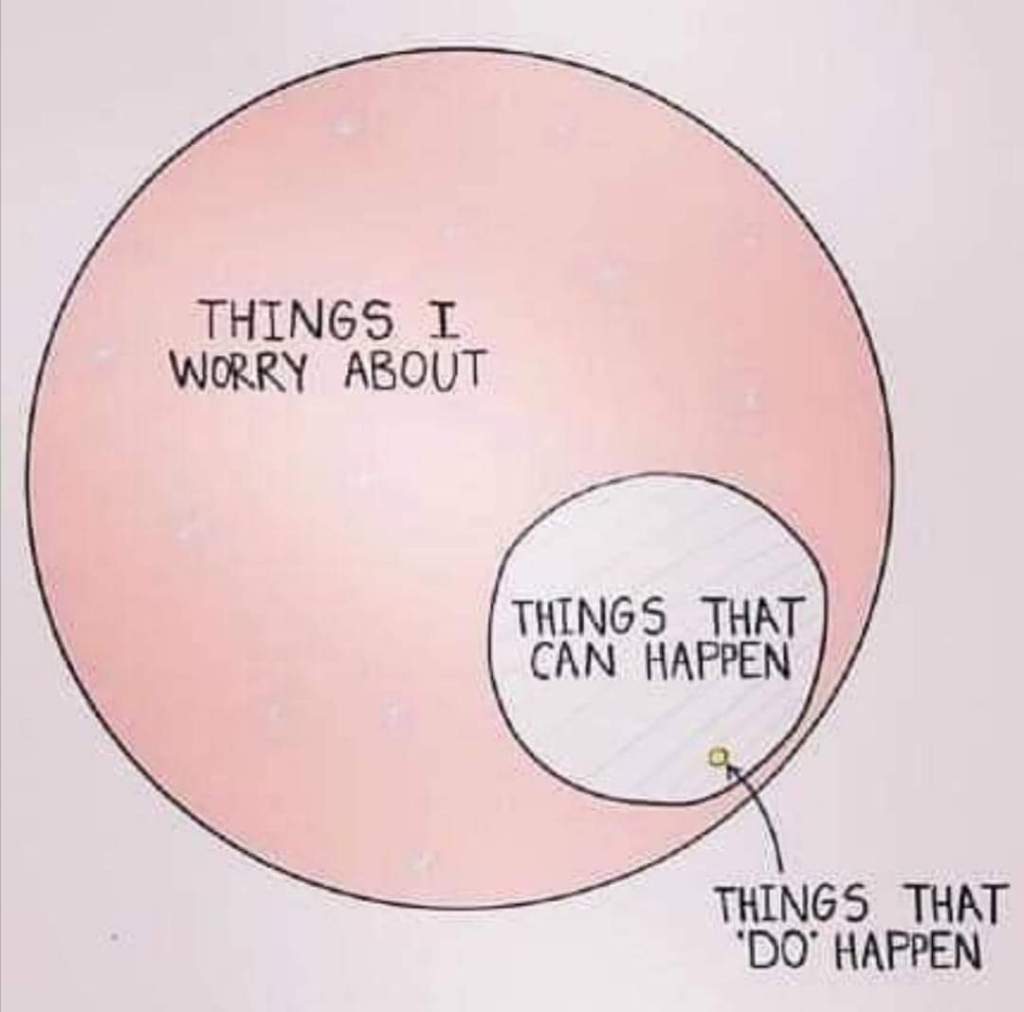
I’m sure if I met you for a chat and asked what you were worrying about, you could string a whole long list of things together. Some would be based on the reality of how you see your current situation, but the majority would come from a perception of what you think might happen.

The image below was shared on social media last week by a few friends and it got me thinking a lot about this. Have a look – does it ring true for you?

We all do it don’t we? And those daily worries are all too good at taking over. Then the more we worry about them, the more we get stuck in an ever downward spiral that can be hard to move out of. I’m also aware that on top of normal things people worry about, the current pandemic has added a whole other layer. So how can we move out of this cycle of worry?

Conquering the cause of worry or anxiety takes time, especially while the symptoms persist. When panic strikes, try these simple tricks to refocus and calm down:

  1. Reset your mind by focusing on another sensation, like the feel of the ground under your feet.
  2. Ask yourself if your negative thoughts are rational.
  3. Breathe deeply, starting at the bottom of your stomach.
  4. Find a quiet space and talk to yourself, using calming and encouraging words.

You can also try this very simple mindset shift as highlighted in the short video below from Simon Sinek.

So here’s your challenge: Change your mindset. Turn the negative into a positive. Turn the worry into excitement. Turn your fear into hope.

As well as following at least some of what has been shared here, coaching can also help you. It won’t give you the answers. But it will help you to ask yourself the right questions that will lead to the answers. It’s about being helped to be the author of your own future. Sounds good right? Why not jump on the waiting list for our free coaching programme right here. What are you waiting for?

Get in touch with me (Dan) at communitycoach@tamfourhilltro.co.uk or 07444 873151

community

Community Assemblies and greater Decision-making powers.

In this week’s Community Safety Blog, I want to reflect upon community decision making and how as a model of active citizenship it can impact positively on all decision-making structures right up to national policy making in government. I have been reading the recently published Citizens Assembly Summary Report and as a model for involving ordinary people with the big issues of the day it has much to offer the practices of community empowerment. Citizens assemblies are new to Scotland, but they have been used successfully in many other nations, Australia, Canada France, Belgium, Poland and most recently the citizens’ assembly in the Republic of Ireland looked at issues including abortion, equal marriage and the opportunities and challenges of an ageing population.

Here are some very brief highlights lifted from our Scottish report:

6.

“The Citizens’ Assembly recommends that in order to

ensure that citizens can make informed decisions in

relation to rebuilding their communities the Scottish

Government and Parliament should:

establish community-based citizens’ assemblies

to assess what is happening in our communities

(including the effects of COVID-19), identify gaps

and recommend actions, including through digital

technology, that can bring people together and make

our communities more inclusive.

In my view this would work well in Camelon and Tamfourhill, it encourages localism and will ensure responses and activities really are appropriate to the needs and aspirations of local people. A local community -based citizens assembly of anywhere between 30 -100 members, they could be picked randomly within agreed demographics to ensure they are representative of the entire population and inclusive of all interests. I have a priority to support the formation of a community safety group for our local areas and this could easily be formed as an Assembly subgroup or community safety could be a key agenda item or theme for consideration by the wider assembly.  There is no reason why individuals could not be requested to participate on a similar basis as being called for jury duty, it could be treated as being a part of your responsibilities as a citizen, time of work would be guaranteed and of course a payment made to all Panel members. Alternatively, we could operate the Assembly in evenings or weekends and gift people for their time and participation.

37.

The Citizens’ Assembly recommends that in order to

overcome the challenges in relation to young people’s

health and wellbeing the Scottish Government and

Parliament should:

invest in and provide opportunities for all young people

to access extra-curricular activities, including sports

and the arts, with support and guidance for young

people to pursue opportunities that are right for them.

Through this national recommendation Young people can thus benefit though the provision of new leisure and creative opportunities, National government are now required to take notice and act upon this decision as agreed by the Assembly. Locally then this would operate along similar lines in Camelon and Tamfourhill, where Falkirk council, Local Community organisations and Statutory Agencies would be required to respond to the decisions reached by our own local Assembly.

I thought that was a particularly relevant recommendation:

55.

The Citizens’ Assembly recommends that in order

to overcome the challenges in relation to providing

equal internet access to all the Scottish Government

and Parliament should:

invest in infrastructure (and utilise existing

infrastructure) to widen mobile networks and remove

black spots, ensuring all communities have access

to the internet through free community hot spots

and publicly available hardware. Internet should be

considered as a basic need, free to all.

This really will address digital exclusion and providing a free phone service, especially for our elderly population would be a significant positive step to combatting social isolation and improving access to vital services.

59.

The Citizens’ Assembly recommends that in order

to ensure that citizens can make informed decisions

in relation to criminal justice reform the Scottish

Government and Parliament should:

undertake a full review of the criminal justice system

to improve outcomes for communities, offenders

and victims. This would include the reintroduction of

community policing, involving citizens in improving

local communications and services.

This could provide a big change to how we deal with criminality and anti-social behaviour and would work well in tandem with more restorative forms of justice and in directly involving the community with resolving the harm that has been done and remedying injustice in a smarter way. This is another area where a local citizens assembly could deliver big changes for the community.

The full Scotland Citizens Assembly report can be found here:

https://www.citizensassembly.scot/main-report

Dan our Community Coach recently in his blog was discussing free money and the Community choices programme, and this is another example of community decision making and an approach to improving grassroots and community democracy through participatory budgeting. We know about the role of community councils but there are other ways where we can enrich and extend local democracy. Oliver Escobar in his recent essay on the Futures in Common (Scotland after the Virus Gerry Hassan & Simon Barrow) discusses democratic innovations and describes processes where big policy-making decisions are conducted and made directly by citizens and not representatives or elected politicians. He lists: Mini-Publics (community assemblies), participatory budgeting (Community choices) and digital crowd sourcing (online decision making) He promotes the idea of Social commons, and this is a radical interpretation of models of community ownership, it has its origins in the common pastures and common lands that everybody once inhabited, enjoyed and utilised. These shared commons were in fact lands and resources held in common a form of community-based governance. We already have local community groups moving in the direction of asset transfers and taking back into community control buildings and facilities and this can be extended into parks and open spaces, canal towpaths, shops, and cafes. This is all about local democracy and community ownership and as we move towards COVID recovery and rebuilding aspects of our communities then this new democratic thinking provides a route map towards a more inclusive citizenship whilst encouraging greater communal responsibility.       

camelon, coach, collaboration, community, development, Our Place, resilience, Support, tamfourhill

Easy as ABCD

Last week, I was lucky to share a powerful couple of hours on zoom with over 120 other people across the UK who are working with their communities to bring positive change. It was called the Asset Based Community Development Jamboree – hence the ABCD heading to this blog. Don’t get put off with fancy words there – what this really means is strengthening communities with what exists already – i.e. the people. To put it another way, as it says in our mission statement, empowering local people & organisations to bring about positive, lasting change. What this boils down to is a community revolution! It’s the time for communities to build on their own skills and be the authors of their own futures.

I was incredibly fired up from the morning in this session, as I was joined by others who are banging the same drum as I have throughout my time in this role and for years before that: stop doing stuff to communities – work with them. I could write forever on this subject but to save boring you (who said “too late”?!), I will just put this over a series of blogs in the coming weeks and months as the mood takes me and as circumstances dictate.

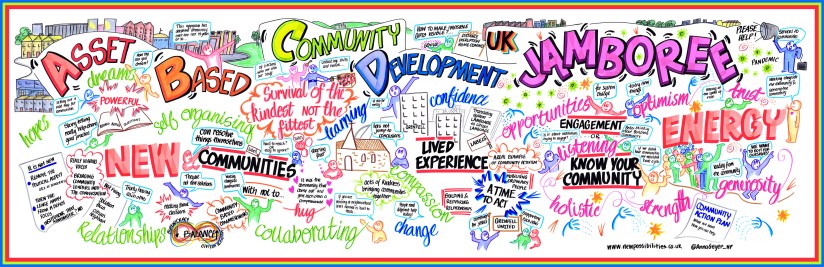
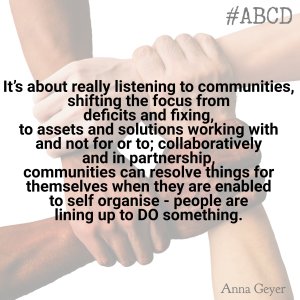
The above image is the graphic notes from the morning, captured by Visual Practitioner Anna Geyer. She has really caught the mood and you can see for yourself that there is so much in there which is why I need a series to bring some of this to a local level. In her twitter summary, this quote really stood out for me:

In every meeting I’ve been in over the last 10 months – especially the current Community Conversations that the Council are leading – I have pressed the point that the whole community needs to be spoken to. Anything dressed up as a conversation cannot fall short and become a place simply for providing information. The people of Camelon and Tamfourhill have some powerful opinions that can really help shape the future of our community. It’s time these opinions were taken seriously and my pledge to you is that I will do what I can to make this happen. But you need to work with me on this.

Back to the ABCD session, below are just some of the comments shared by participants that I managed to capture and feel are relevant to us here. The first 5 quotes come from Fatima El Guenuni, a family therapist in the Grenfell area of London who had family members in the tower that burned down (thankfully they survived). Her talk certainly set the tone for the day:

  • Communities have never been hard to reach, but they have been easy to ignore.
  • Voice is important at the centre of communities but action is more important.
  • Work alongside people and be brave enough to make decisions that benefit the community and not the system.
  • It’s the system that marginalises communities, not communities that make themselves hard to reach.
  • We need to be willing to step outside roles & be there for communities with love and support – a hug of compassion and humanity.
  • Be the “human bridge” between people and the community and the system.
  • It is time to stop the politicisation of community development.
  • This citizen centred movement is gathering massive momentum. I hope councils learn, recognise it & work generously with communities to share power & space.
  • We are hearing of rooted acts of kindness, and the tremendous steely courage of communities, to flourish forward fairly, whatever the challenges may be.
  • Stories are so important and then stimulating them with the right questions.
  • Inequalities have driven the change. Our aim was to listen. Serve the people. Unlock skills and talents. Change power.
  • We need jargon free community development. It’s about people. Local people. Leading local change.

There are so many more that I’ll save for another blog. But can you pick up the themes here? Are you excited by it? Everyone was completely on board with this revolution. This last year has actually been a defining moment for communities across the land, as many have really stepped up to meet their own needs. The challenge now is to build on that, with appropriate support and empowerment, to make this change in power permanent.

I’ll finish this week where I started, with the letters ABCD, standing for Asset Based Community Development. For a bit of fun following a challenge by a Community Builder from the Denny area, I extended this for the whole alphabet, so our A to Z of Community Development is now: Asset Based Community Driven Efforts For Growing Hope, Increasing Joy, Keeping Lives Motivated, Nurturing Others, Persevering, Quickly Reaffirming, Strengthening Talents, Unleashing Volunteers With eXtra Youthful Zest.

So who’s up for joining in on this community revolution? Let’s hear your voices – your comments, concerns, suggestions, hopes, plans. What do you need to help take you forward? Is it other people? Money? Training? Property? Equipment? Other resources? Let us know and we can then work with you to try to make it happen.

Dan Rous, Community Coach, 07444 873151, communitycoach@tamfourhilltro.co.uk